
By Texas Heart CPR Training Instructor Team, American Heart Association Aligned Training Site · · 14 min read
CPR Certification Online: What Actually Counts
CPR certification online starts with a web course, but an accepted AHA card always needs a hands-on skills test. Find out what counts and how to get yours.
You can finish the cognitive part of a cpr certification online, but if your employer, licensing board, or clinical site requires an American Heart Association card, you also need a short in-person skills test. That blended path - AHA online course plus a hands-on check at a certified site - is the honest route to a same-day eCard valid for two years. It is the one we run every day at Texas Heart CPR Training, where our instructor team has taught hands-on BLS, CPR, AED, First Aid, ACLS. PALS classes across Plano, Dallas, and Fort Worth since 2009.
You have probably seen sites promising a fully online CPR card in under an hour, and you are wondering if that card will actually work when your nursing program or construction supervisor asks for it. The short answer is that most of those pure-online certificates get rejected by healthcare employers and OSHA-regulated workplaces. We will walk through exactly what counts, which cards are accepted, and how to get certified without wasting time or money on a card nobody will honor.
Key Takeaways- A true cpr certification online is a two-step process: finish the AHA HeartCode online course, then book a 30- to 60-minute hands-on skills test at an AHA Certified Training Site.- You leave with the same AHA eCard a full classroom student earns, and it is valid for two years.- An ACLS or PALS skills test costs $100; call 214-592-7088 for current BLS and HeartSaver skills-test pricing.- We hold skills-test appointments Monday through Saturday, 7:00 a.m. to 7:00 p.m., at our Plano, Dallas, and Fort Worth centers.- Before you pay for any online CPR card, email your employer or program director and ask whether they require an AHA or ASHI card.
Can You Get CPR Certified Entirely Online?
No - not if you need a card that a hospital, clinic, school district, or OSHA safety officer will accept. The American Heart Association, whose BLS and ACLS cards are the healthcare standard, does not issue a provider eCard for any course that is fully online. Every AHA certification path ends with a hands-on skills session with a certified instructor.
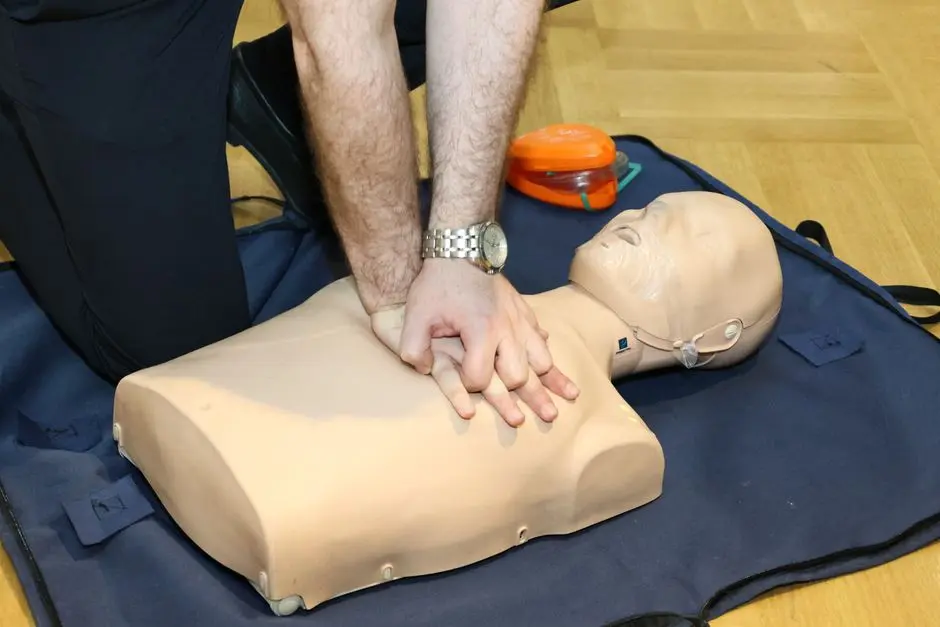
You can complete the cognitive portion of a cpr certification online through the AHA's HeartCode platform. That part is self-paced and covers the science, the steps, and the decision-making. But before the AHA will release your eCard, you must demonstrate chest compressions, ventilations, and AED use on a manikin while an instructor watches and corrects your form. There is no workaround for that step.
That requirement exists for a reason that goes beyond a credential. More than 356,000 out-of-hospital cardiac arrests happen in the US each year, and only 40.2% of those victims receive bystander CPR[1]. Worse, 73.4% of cardiac arrests happen at home[2]. The person giving CPR is often a family member. The AHA's position, and ours after teaching more than 77,654 students[3] since 2009, is that a video alone does not build the muscle memory to push hard and fast on a real chest when someone collapses in front of you.
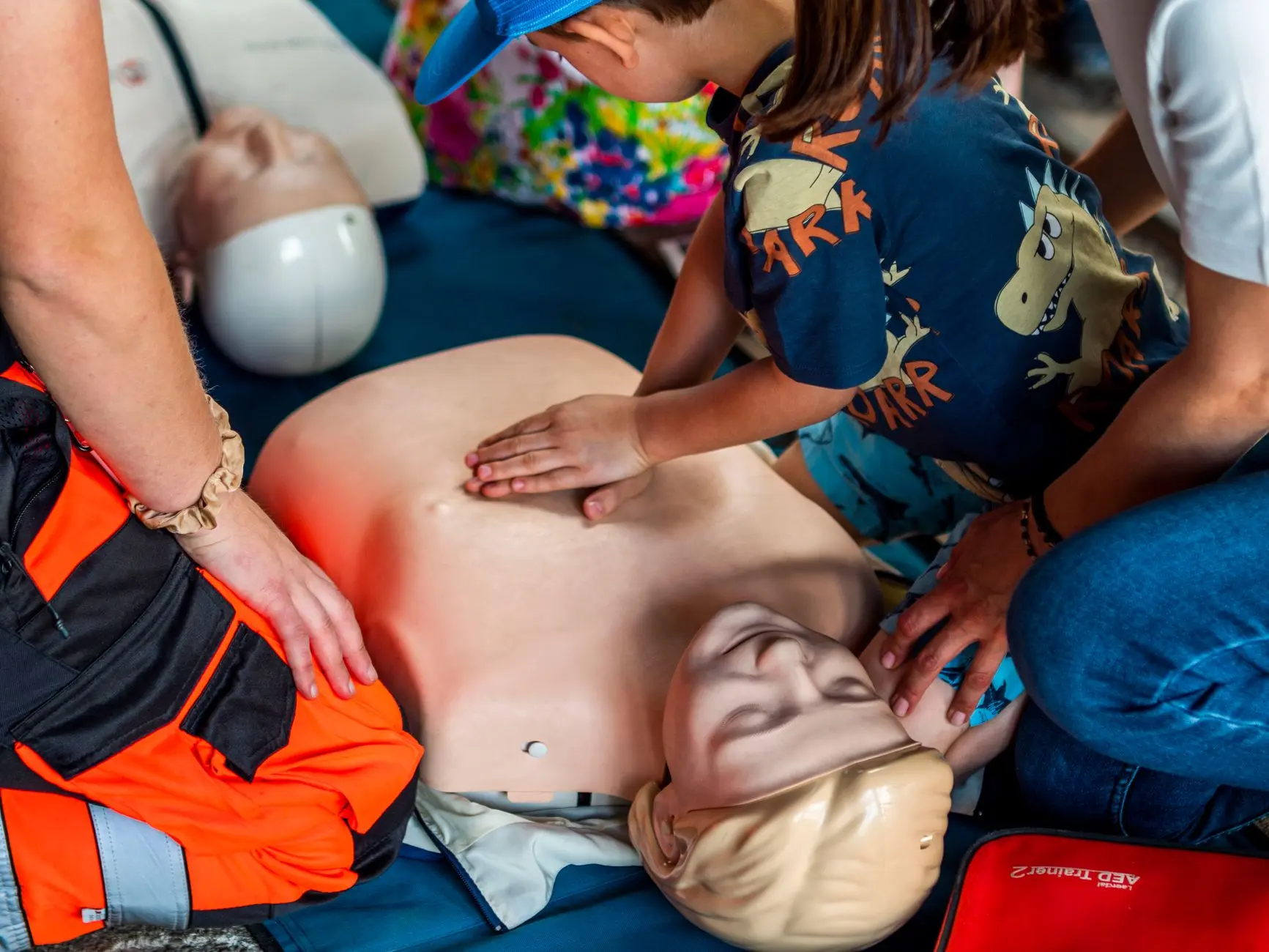
A PRESTAN manikin gives you real-time feedback on compression depth and recoil. Green lights show when you are in the zone. Red lights show when you are not. That feedback is the difference between freezing and acting when it counts. The most common error we see is compressions that are too shallow. The manikin's red light tells the student immediately, and our instructor corrects the depth before the habit sets. CPR performed immediately can double or triple the chance of survival from an out-of-hospital cardiac arrest[4].
We run BLS, HeartSaver, ACLS, and PALS hands-on skills tests at our Plano, Dallas, and Fort Worth centers for people who completed the AHA online course. The test itself is not a full class. It is a focused 30- to 60-minute session where you show your compressions, bag-mask ventilation, and AED prompts on the same equipment our classroom students use. Our instructors hold both American Heart Association and American Safety and Health Institute certifications[5], so our instructors run the skills check to the exact standard your employer expects.
Which Online CPR Certification Cards Employers Actually Accept

Healthcare employers and regulated facilities almost always require an AHA BLS Provider card for clinical staff. For teachers, coaches, daycare workers, and construction crews, the accepted card is usually an AHA HeartSaver or an ASHI First Aid with CPR/AED certification that meets OSHA compliance. A generic online CPR certificate from a non-accredited website rarely satisfies either standard.
The AHA Rule: Every AHA Card Requires an In-Person Skills Check
We are an American Heart Association Certified Training Site and our instructors hold both AHA and American Safety and Health Institute certifications. When you take a skills test with us after an AHA online course, we issue the same eCard a classroom student earns. There is no notation that says "online" or "skills test only." It is the same card, and it is accepted the same way.
James D., a healthcare professional in Plano, completed his AHA BLS Provider course at our K Avenue center in April 2026. In his public review he described the instructor as friendly, helpful, informative, and thorough, and said he would recommend the location to his colleagues[6]. His employer accepted the eCard without question because it was an AHA card from an AHA-aligned site.
The practical rule is simple: before you pay for any cpr certification online, email your employer, program director, or safety officer and ask whether they require an AHA or ASHI card. If the answer is yes, skip the online-only certificate and go straight to the blended path.
The Blended Path to CPR Certification Online: AHA Online Course Plus a Hands-On Skills Test
The blended learning route is the fastest honest way to get an employer-accepted cpr certification online. It has three steps, and we will walk through each one so you know exactly what to expect.
Step 1 - Complete the AHA Online Course
Purchase and finish the AHA HeartCode course for your required certification level - BLS, ACLS, PALS, or HeartSaver First Aid/CPR/AED - directly on the AHA's website[7]. The online portion is self-paced and covers the algorithms, science, and video demonstrations. Most students finish it in two to four hours, though you can stop and resume as needed.
Step 2 - Book Your Skills Test (What to Expect in the Room)
Once you have your HeartCode completion certificate, schedule a hands-on skills test at an AHA Certified Training Site. We offer BLS, HeartSaver, ACLS, and PALS skills tests at our three DFW centers. An ACLS or PALS skills test costs $100[8]. Call 214-592-7088 for current BLS and HeartSaver skills-test pricing.
When you arrive, the instructor hands you a PRESTAN manikin with real-time feedback lights and watches you perform the same skills you studied online: adult and infant compressions, bag-mask ventilation, AED operation, and team dynamics for ACLS and PALS. The session is not a re-teach of the whole course. It is a focused assessment where the instructor verifies that you can perform to the AHA's standard and gives you a correction if your depth, rate, or recoil is off. Most people finish in 30 to 60 minutes. Sherry Mehring, who took her BLS Provider course with us, described the instructor as someone who "met you at where you were at" and "taught with the firm authority & gravitas that these situations deserve BUT was also kind in delivery"[9].
Step 3 - Walk Out With a Same-Day eCard, Valid Two Years
After you pass the skills check, we issue your AHA eCard the same day. It arrives by email before you leave the parking lot, and it is valid for two years from the issue date. The eCard is verifiable on the AHA's public lookup system, so any employer or program director can confirm it is real in seconds. If you ever need to pull up your card later, you can use the AHA's CPR certification lookup tool.
Rids, who has returned to our Plano center for her CPR certification renewal every two years for six years, described the class as quick, efficient, and covering all the essential hands-on techniques without wasting time[10]. That is the experience the blended path is designed to deliver: no repeated lecture, just the hands-on work that matters.
Is Being CPR Certified the Same as First Aid Certified?
No. CPR certification covers chest compressions, rescue breaths, and AED use for cardiac and respiratory emergencies. First Aid certification is a separate set of skills - bleeding control, burn care, splinting, seizure response, and managing shock - and it requires its own course and skills check.
Some classes combine both. Our ASHI First Aid with CPR/AED course, for example, covers the full First Aid curriculum plus adult and pediatric CPR and AED training in one session. It meets OSHA and USCG compliance requirements and is the card most employers ask for when they say "First Aid and CPR certified." Our instructors hold both American Heart Association and American Safety and Health Institute certifications, so the ASHI card you earn carries the same accredited weight as an AHA card for workplace compliance.
Rosalee Chan needed exactly that combined certification for the sports facility where she coaches. She wrote, "I took the CPR/AED with First Aid training to get the certification required by the sports facility that I coach at."[11] She scheduled and paid for the class online and completed the hands-on CPR, AED, and First Aid training at our Plano center. Her employer accepted the ASHI card because it covered both skill sets in one accredited course.
If your employer or program asks for a First Aid card, a CPR-only certification will not satisfy the requirement. Confirm which one they need before you book, and if they need both, choose a combined class so you handle it in a single session.
What Is the Quickest Way to Get CPR Certified?
The quickest route to an employer-accepted CPR card in DFW is the AHA blended path: complete the HeartCode online course at home, then schedule a same-day or next-day skills test at one of our three training centers in Plano, Dallas, or Fort Worth. You can finish the online portion on a Saturday morning, drive to the nearest center, and have your eCard in your inbox by early afternoon.
We hold skills-test appointments Monday through Saturday from 7:00 a.m. to 7:00 p.m., and we serve more than 40 surrounding cities across the metroplex with both in-center and on-site options. If you are renewing an existing AHA card, the process is even faster because you already know the material - most renewal students move through the skills check in under 45 minutes. For a detailed walkthrough of booking, see our guide on how to schedule your CPR class in DFW.
Kim, who has been coming to us for six years for her CPR recertification, wrote that instructor Kaela was the best she has had and that she plans to return in two years when her card is due again[12]. That rhythm - online cognitive refresher, short in-person skills test, same-day eCard - is the fastest pattern we see for healthcare providers who recertify on a deadline. Our instructor team has taught hands-on BLS, CPR, AED, First Aid, ACLS, and PALS classes across Plano, Dallas. Fort Worth since 2009, so the skills check is efficient and focused on the techniques that matter.
Red Flags: Online CPR Certification “Cards” Employers Won’t Accept
A quick web search for cpr certification online turns up dozens of sites offering a printable CPR card in under an hour with no skills test. Before you pay for one, here are the signs that employers will likely reject the card.
- No hands-on skills check. Any course that issues a CPR card without an in-person skills assessment is not AHA- or ASHI-accredited. Healthcare employers and OSHA-regulated workplaces require a skills check.
- No AHA or ASHI logo. If the card does not carry the American Heart Association or American Safety and Health Institute mark, it is not the industry standard. Some online-only sites use logos that look official but are not.
- Instant card after a quiz. A multiple-choice quiz alone does not meet the AHA's requirements for a provider eCard. If the site promises a card immediately after the online test with no skills session, the card is not AHA-issued.
- Price under $20. An AHA HeartCode online course costs $37 paid to the AHA, and the skills test adds $40 to $100 depending on the level. A site offering a complete online CPR certification for $19.95 is selling a certificate of completion, not an accredited provider card.
- No verifiable instructor or training site. An AHA eCard is verifiable on the AHA's public lookup system. A non-accredited certificate has no such verification, and an employer who checks will see it is not in the system.
We are an American Heart Association Certified Training Site and an American Safety and Health Institute Certified Training Site. Our Plano center holds a 4.8-star rating from 147 Google reviews[13]. When a student hands an employer one of our eCards, the employer can look it up on the AHA site and confirm it was issued by a real, aligned training center - not a website with no physical location and no instructor.
How to Schedule Your Skills Test in DFW
If you have already finished the AHA HeartCode online course, you can book your skills test at the center closest to you. If you want the full blended learning CPR course from start to finish, we can walk you through the online course registration and schedule your hands-on session in the same call.
We have three DFW training centers - Plano, Dallas, and Fort Worth - and we also run on-site group skills tests at businesses, clinics, schools, churches, and homes across more than 40 surrounding cities. On-site BLS and First Aid sessions need a minimum of nine students. ACLS on-site sessions need a minimum of five.
The Plano center at 2600 K Avenue, Suite 135, is open Monday through Saturday from 7:00 a.m. to 7:00 p.m. We can usually book your skills test within one to three business days of your call, and we can often accommodate a same-day request if you call early in the morning. If you are coming from a BLS online course, read our breakdown of the BLS skills test process in Dallas so you know exactly what to bring.
Our students return because the process works. Kim and Rids have each been renewing with us for six years. James D. completed his BLS and recommended the location to his colleagues the same week. The blended path - AHA online course, a short hands-on skills test at a real DFW center, and a same-day two-year eCard - is the cpr certification online route that actually satisfies an employer's requirements.
Call us at 214-592-7088 or visit our schedule page to pick your date and location. If you are searching for a cpr skills test near me, our Plano, Dallas, and Fort Worth centers cover the full metroplex.
Frequently asked questions
What are the 7 steps in CPR? We teach the AHA's adult CPR sequence in every BLS and HeartSaver class. You learn to check the scene and the person, call for help and get an AED, open the airway, check for breathing, deliver chest compressions at the proper rate, give rescue breaths. Repeat the cycle until help arrives or the AED prompts you to stop. You practice these steps on a PRESTAN feedback manikin so you feel the correct depth and see the real-time lights that tell you when your compressions are on target.
How to get a CPR and first aid certification at no cost? There is no legitimate no-cost path to an AHA or ASHI CPR and First Aid certification card. Some employers, schools, and community organizations sponsor the cost of a class for their staff or volunteers, so ask your HR department or program director if they cover it. Online certificates that skip the hands-on skills test are not AHA- or ASHI-accredited and are routinely rejected by healthcare employers.
How hard is it to pass CPR certification? Passing an AHA CPR skills test is not difficult if you practice the compression rhythm and watch the feedback lights on the manikin. The instructor is there to coach you, not to fail you. Most students who complete the online HeartCode module pass the hands-on skills check on their first attempt because the manikin's real-time feedback shows you exactly what to adjust.
Is there a minimum age to learn CPR? No. There is no mandatory minimum age to learn CPR. Body strength matters more than age - a student needs enough upper-body strength to compress an adult manikin's chest to the correct depth. The PRESTAN feedback lights we use in every class are especially helpful for younger or smaller students because the green light confirms the compression is deep enough, removing the guesswork.
Which CPR class do I need? Healthcare providers and nursing students need AHA BLS. Teachers, coaches, daycare staff, and construction crews typically need an ASHI First Aid with CPR/AED or AHA HeartSaver card that meets OSHA compliance. If your employer or program has not specified, ask them before you book. We can help you identify the right class once you know what your facility requires.
Do I need to be a medical professional to take BLS? No. Anyone can take BLS certification, though it is required for most healthcare providers. The course covers the same high-quality CPR and team-dynamics skills whether you work in a hospital or are taking it for a non-clinical job that asks for a BLS card.
Will my certification card be accepted by my employer or facility? An AHA BLS, ACLS, PALS, or HeartSaver eCard from an AHA Certified Training Site is accepted by virtually every US healthcare employer and by most schools, clinics, and regulated workplaces. Acceptance always depends on the specific facility's policy, so we tell every student to confirm with their employer or program director before class. We work with facilities to make sure the card meets their requirements, and the same-day eCard you earn through a cpr certification online blended path carries the same weight as a full classroom card.